Bursts, not mean shifts
Testing temporal bursts on an immersive hardware-RNG platform.
The Science of Consciousness 2026 · Session THU-2 · Thursday 15 October · Dockside Room
Five parts, and the methodological labels matter
1
The shift
Why a temporal-burst endpoint rather than a cumulative mean, and what that commitment costs.
2
Three exploratory deployments
A festival, New Year's Eve with a hidden control, a paired home run. All exploratory, labelled so.
3
The sealed follow-up
Hidden pre-committed windows, three arms, a control ladder, a fixed analysis plan.
4
What the corpus shows so far
Interim per-run and pooled figures across 79 runs, with exclusions and controls stated first.
5
Boundaries
Assumptions of the test, multiplicity, attribution, limitations, and what would change our minds.
Electronic QRNG: quantum tunneling and avalanche breakdown
Physical Source
Quantum Avalanche Diode
ubld.it TrueRNG v3. Physical entropy derives from carrier tunneling and avalanche breakdown in a reverse-biased semiconductor junction.
Literature Class
Electronic QRNG
Classified under electronic QRNGs (Herrero-Collantes & Garcia-Escartin 2017), distinct from optical beam-splitters but fundamentally quantum in origin.
Hardware Whitening
Galois-field conditioning
An internal MCU applies a deterministic 20:8 whitener before USB egress. Upstream whitening attenuates diode-level bias rather than creating it.
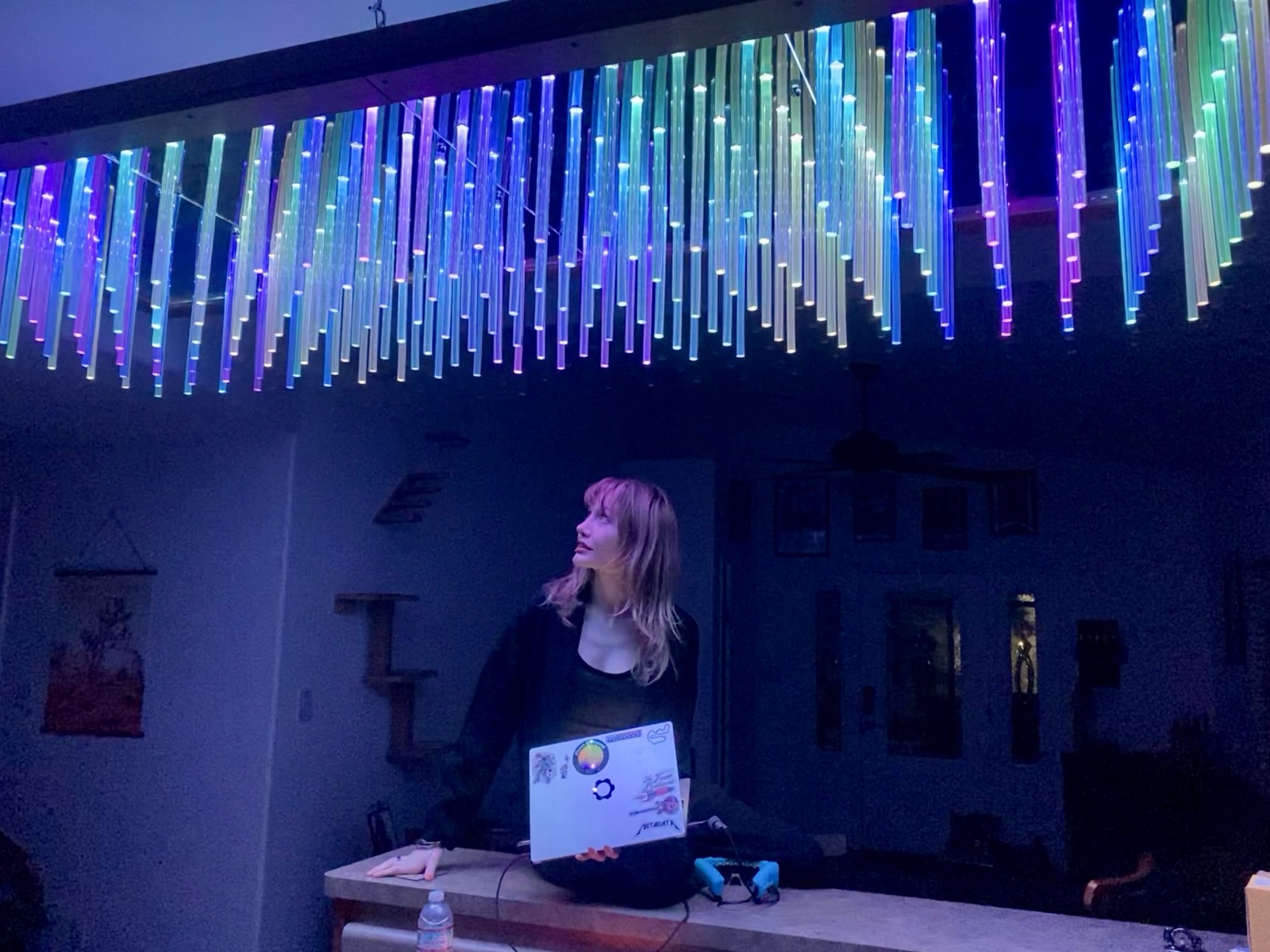
Room-Scale Capability
192-rod chandelier & 1,000+ LED array
Physical solenoid chimes and room-scale addressable LEDs driven live by avalanche diode entropy dynamics.
Confirmatory Solo Workstation
Extended display in darkened room
In formal confirmatory runs, the operator viewed the light display on an extended monitor in a darkened room for controlled solo focus (visual-only feedback; audio chimes were not used in these experiments).
Aesthetic Shift
Absorption vs. effort
Replaces inert on-screen fixation targets (PortREG) with effortless aesthetic absorption in an active visual feedback loop.
Real-time entropy maps directly to visual pattern noise and coherence
Hardware conditioning is upstream, deterministic, and destroys signal
Step 1
Physical Junction
Avalanche breakdown in reverse-biased Zener diode generates raw microvolt noise.
Step 2
Galois-Field Whitener
On-board microcontroller runs a 20:8 linear feedback mixer across raw bits before USB transmission.
Step 3
Host Ingestion
Host reads conditioned serial bytes. Scored channel is bit-count deviation per 60-second period.
Step 4
Display Mapping
Period deviation z maps directly to glitch factor on LED grid / monitor (and chandelier chimes on room rig).
Cumulative means cancel episodic deviations; burst detection isolates them
The Effect Size Problem
Canceling signed means
Historical micro-PK effect sizes were microscopic (π = 0.5003, h = 0.0006) because averaging signed bits (Σz / √N) cancels alternating positive and negative bursts to zero.
Unsigned Mean |z|
Preserving volatility
Folded normal deviation: measures amplitude of departures regardless of sign. Redefines effect size from directional drift to temporal volatility.
Thresholded Bursts
Tail clustering in time
Counts 60-second periods where |z| ≥ 1.96. Powered specifically for concentrated, episodic bursts rather than uniform, smeared drift.
Measuring the empirical baseline rather than assuming an idealized normal
The Textbook Assumption
Ideal standard normal
Assumes |z| ≥ 1.96 occurs at exactly 5.000%, periods are independent, and serial autocorrelation is zero.
Empirical Hardware Reality
Finite sampling & serial noise
Real physical USB hardware exhibits minor temperature drift, serial buffering latency, and localized variance shifts.
The Calibration Protocol
Internal baseline as control
Every run measures its own empirical baseline periods outside focus windows to evaluate whether in-window deviation exceeds chance.
Four-day public festival installation: aggregate-null with a localized peak
Scale
4 days, 24.5M bytes
October 2025 public installation. 3,222 sixty-second periods of continuous unattended and attended logging.
Overall Run
Flat aggregate-null
Overall burst rate was 4.28% (vs 5.00% expected), with overall mean |z| completely consistent with chance.
Coincidental Cluster
Peak anomaly z = 3.31
Unannounced arrival of experienced meditators coincided with the single highest deviation window of the run (p < 0.001, uncorrected).
Attended unit vs. hidden second unit: aggregate-null and a design lesson
The Setup
Two simultaneous units
Attended unit drove the live room installation. A second identical unit recorded silently in the same room behind a barrier.
The Outcome
Both aggregate-null
Neither attended nor hidden unit showed significant overall deviation across the multi-hour evening.
The Engineering Lesson
Feedback polarity matters
High-noise visual mapping rewarded entropy over signal: visual glitch was aesthetically appealing, creating negative feedback polarity.
Attended TrueRNG vs. simultaneous PRNG control on identical host
| Metric | Attended TrueRNG v3 | Simultaneous PRNG Control |
|---|---|---|
| Total Periods | 1,000 sixty-second periods (16.7 h) | 1,000 sixty-second periods (identical host) |
| Overall 16.7h Mean | Aggregate null (|z| mean = 0.796) | Aggregate null (|z| mean = 0.798) |
| Focus Windows (9 windows, 107 periods) | 10.3% burst rate vs 3.9% baseline p = 0.007 (circular-shift placement) | 4.7% burst rate vs 4.8% baseline p = 0.54 (completely flat) |
| Sensitivity Checks | p from 0.003 to 0.059 across parameter variations | Null across all parameter sweeps |
Why compelling qualitative phenomena and suggestive deployments cannot settle the hypothesis
Qualitative & Field Clues
Windows defined after data existed
Father's memorial balloon release (z = 4.04), singing and piano flow, festival meditators (z = 3.31). Deeply evocative, but post-hoc observation is not proof.
The Multiplicity Problem
Degrees of freedom nobody can count
Multiple sites, informal observations, flexible time windows. The denominator for a corrected p-value does not exist, so uncorrected values cannot be interpreted.
The Only Scientific Exit
Fix everything before the data
Window times, threshold, endpoint, exclusion rules, and analysis code, hashed in git before each session. That is the confirmatory architecture.
The exploratory phase did its job: it produced compelling qualitative phenomena and a hypothesis sharp enough to be wrong. The next section details how it is being tested.
Hidden, pre-committed focus windows inside continuous collection
| Element | Specification |
|---|---|
| Session | Six hours of continuous collection (~380 sixty-second periods); 3.3-hour form (~200 periods) with 4–5 windows |
| Windows | Ten non-overlapping 15-minute focus windows per six-hour run, minimum 15-minute separation |
| Placement | Generated from a fixed seed before the session starts; operator is blind to times; an alerter signals onset/offset |
| Feedback | Interleaved ON (glitch coupled to stream) and OFF (glitch held at matched constant intensity), balanced within session |
| Baseline | Every period outside a window, less a fixed five-period post-window buffer (K = 5) |
| Instrument | 10,400 bytes per period, verified every period; different byte counts belong to separate strata |
What is committed, and what that is worth
Mechanism
SHA-256 Hash before data
Each session writes a SHA-256 hash of its schedule before the first window opens. Schedule regenerates from its seed. 68 commitments are published; seeds withheld until analysis lock.
The limit
No external registry entry yet
Nothing is lodged at OSF or the KPU registry, so there is no independent public third-party timestamp. Publishing hashes in git does not backdate them; lodging them externally is the next step.
| Selection channel (decision augmentation) | Status under this design |
|---|---|
| Session and window timing | Closed. Fixed and committed before data exist; operator is blind to placement |
| Attendance | Open. Operator-attested per window, recorded in the run directory |
| Inclusion, exclusion, analysis choices | Open. Mitigated by dated written disclosures and fixed analysis code, not eliminated |
One confirmatory contrast, two exploratory operators, two kinds of control
Confirmatory
Human solo operator
Attended, live feedback, hardware source. The primary condition the hypothesis concerns.
Confirmatory contrast
Unattended same-device
Same schedule, alerter and code path, nobody in the room. Defends a device-level claim.
Exploratory
Language-model operator
A pinned model snapshot (claude-fable-5) in the operator role, prompted toward the window's target.
Exploratory
Human + model companion
Human operator with a co-meditating model in the loop. Its own stratum, never pooled into solo data.
“Operator” is used functionally: a process receives a goal, interacts with the loop, and produces condition-specific action. Nothing assumes the model is conscious, and a positive result would not show consciousness is unnecessary: humans chose the model, prompt, timing and analysis.
Each control answers exactly one question, and here is where each rung stands
| Control | Question it answers | What it cannot answer | Status |
|---|---|---|---|
| PRNG, no schedule | Does the analysis path produce structure from a stream nobody could influence? | Anything window-locked | Run (June 2026) |
| PRNG + schedule + alerter | Do the machine events at window onset manufacture the endpoint? | Anything about the device | Two runs (29 Sep, 5 Oct) |
| Unattended HWRNG + schedule | Does the device produce the endpoint at this rate with nobody engaged? | Separating presence from attention | Not yet run; 15 to 20 needed |
| Attended, present but not focusing | Is it the person's attention, or the person's body near the instrument? | – | Not yet run |
Fixed in the design document, and dependence-preserving
Primary Endpoint (Dispersion)
In-window vs baseline mean |z|, by circular shift
Continuous unsigned deviation contrast, 20,000 circular shifts of window mask within each run. Run-stratified: runs never concatenated.
Secondary Endpoint (Bursts)
Burst rate, |z| ≥ 1.96
In-window vs baseline exceedance rate: placement test on rate difference, Mantel-Haenszel odds ratio across runs, Fisher exact per run.
Secondary Factor
ON vs OFF windows
Exact permutation of window labels within run, combined across runs. Evaluates live stream coupling vs constant glitch.
79 valid runs: 740 of 748 physical checks pass (98.9%)
79
valid runs analyzed across all arms (2026-06-27 to 2026-10-05)
251.6 M
raw bytes evaluated across >24,000 sixty-second periods
681
delivered focus windows across 73 windowed runs
| Check | Result |
|---|---|
| Physical Hardware Tests | Bit-position balance, byte chi-square (df=255), variance & lag-1 autocorrelation: 740 / 748 checks pass (98.9%) at 99% simulation bounds. 8 failures observed vs. 7.5 expected by chance under ideal randomness. |
| Collection Integrity | Uniform 10,400 bytes/period, 0 duplicate timestamps, 0 duplicate reads, exact raw z-score reproduction (|z_raw - z_logged| < 10^-6). |
| Documented Disclosures | All anomalies disclosed in-directory: SOLO-13 delivered 7 of 10 windows (power loss), COMPANION-13 logged clock drift, SOLO-26 excluded window 10 per attendance log. |
Circular-shift test: 15 of 73 windowed runs clear p < 0.05 (~3.7 expected)
| Run | Arm | Periods (In / Base) | In-Window |z| | Baseline |z| | Enrichment | Shift Null (p) |
|---|---|---|---|---|---|---|
| SOLO-13 | solo (3.9h) | 105 / 98 | 1.0469 | 0.6278 | +0.4191 | p < 0.0001 |
| SOLO-14 | solo (6.3h) | 150 / 179 | 0.9865 | 0.6787 | +0.3078 | p < 0.0001 |
| SOLO-23 | solo (6.3h) | 150 / 178 | 0.8858 | 0.7173 | +0.1685 | p < 0.0001 |
| SOLO-25 | solo (6.3h) | 150 / 179 | 0.9497 | 0.6801 | +0.2696 | p < 0.0001 |
| SOLO-38 | solo (3.3h) | 60 / 119 | 1.0107 | 0.8185 | +0.1922 | p = 0.0047 |
| SOLO-19 | solo (6.3h) | 150 / 179 | 0.9362 | 0.7470 | +0.1892 | p = 0.0056 |
| SOLO-17 | solo (6.3h) | 150 / 179 | 0.8733 | 0.7292 | +0.1441 | p = 0.0060 |
| PRNG-SCHED-1 | control (6.7h) | 150 / 202 | 0.9228 | 0.7266 | +0.1962 | p = 0.0383 |
What the pooled table can and cannot say
| Stratum | Runs | In-win | Base | Δ | p |
|---|---|---|---|---|---|
| Human solo, all runs | 36 | 4,923 | 5,911 | +0.0314 | p = 0.0062 |
| Human Solo (Calibration Gate-Passing Only) | 25 | 3,353 | 4,014 | +0.0124 | p = 0.2278 |
| PRNG scheduled controls | 2 | 300 | 408 | +0.1413 | p = 0.0224 |
Burst clustering: Odds ratios reach >7× in top runs
15 / 73
runs clear placement test on burst rate differences at p < 0.05
14 / 73
runs show significant burst odds ratios by Fisher exact test (p < 0.05)
11.31 ×
maximum observed single-run odds ratio (SOLO-25: 11.3% vs 1.1% bursts)
Top single-run burst ratios
SOLO-25 (OR 11.31), COMPANION-6 (OR 10.63), INTERLEAVE-4 (OR 9.49), SOLO-13 (OR 9.27)
In-window burst rates reach 11%–16% against 1%–2% baselines, generating massive localized odds ratios.
Why caution is required
Small baseline denominators
An odds ratio built on 2 baseline bursts in 180 periods has wide confidence intervals. Placement p-values remain the robust metric.
Placement test agreement
15 placement hits (20.5%)
The 20,000 circular-shift placement test agrees strongly with primary mean |z| enrichment, confirming temporal burst clustering.
Does live visual coupling modulate the effect? So far, no
The Contrast
Balanced within every run
Half the windows couple display glitch to the live stream; half hold glitch at matched constant intensity. Operator does not know which is active.
Pooled Human Solo Arm
Minimal difference
ON minus OFF difference in mean |z| is modest (+0.019); per-run exact permutation tests yield 1 in 36 below 0.05, perfectly consistent with chance.
Physical Meaning
Coupling vs. Immersion
OFF removes the live stream coupling, NOT environmental immersion: the 192-rod chandelier and LED grid still run at matched constant glitch.
Automated sessions on claude-fable-5: one nominal hit, pooled null
| Session | Model Snapshot | Windows | Periods (In / Base) | Enrichment | Shift p | Burst In vs Base |
|---|---|---|---|---|---|---|
| Pilot (7 Jul) | claude-fable-5 | 24 × 5 min | 121 / 601 | -0.068 | p = 0.829 | 3.3% vs 5.8% |
| Overnight (4 Aug) | claude-fable-5 | 32 × 5 min | 164 / 33 | +0.122 | p = 0.088 | 7.9% vs 6.1% |
| Overnight (25 Aug) | claude-fable-5 | 32 × 5 min | 165 / 31 | +0.196 | p = 0.027 | 6.1% vs 0.0% (OR = ∞) |
| Overnight (3 Sep a) | claude-fable-5 | 32 × 5 min | 169 / 30 | -0.104 | p = 0.823 | 4.7% vs 10.0% |
| Overnight (3 Sep b) | claude-fable-5 | 32 × 5 min | 166 / 30 | -0.326 | p = 1.000 | 4.8% vs 10.0% |
PRNG controls calibrate chance; unattended HWRNG runs remain critical
| PRNG + Schedule (29 Sep) | PRNG + Schedule (5 Oct) | Unattended HWRNG + Schedule | |
|---|---|---|---|
| Periods (In / Base) | 150 / 202 | 150 / 206 (7 host-suspend gaps) | – |
| Enrichment, Shift p | +0.196, p = 0.0383 | +0.086, p = 0.1276 | Not yet run |
| Burst Rate (In vs Base) | 10.0% vs 5.5% (p = 0.3043) | 6.0% vs 3.9% (p = 0.1866) | – |
Reading PRNG results
A software PRNG cannot hear intention
Raw PRNG bytes pass all uniform tests. Single-run p = 0.038 reflects natural sampling variation in a finite test series.
What it calibrates
Enrichments of +0.2 happen by chance
The control's +0.196 provides a vital benchmark for interpreting moderate single-run human arm enrichments.
What is needed
Unattended hardware runs
15–20 unattended same-device runs with active schedules are required to establish the definitive physical baseline.
The permutation test is valid, but not assumption-free
Core assumption
Phase exchangeability
Requires that the underlying time series is stationary across circular offsets, so shifted masks serve as valid null realizations (Harris 2024).
Diagnostic checks
Stationarity verification
Per-run linear drift slopes, 15-period rolling variance, and autocorrelation checks evaluate whether stationarity holds across circular wrap boundaries.
| Parameter fixed in advance | Methodological rationale |
|---|---|
| Fixed circular shift offsets (20,000 permutations) | Conservative bound on p-values preserving empirical serial dependence |
| Ties broken uniformly; observed shift included (k+1)/(N+1) | Guarantees strictly valid, conservative empirical p-values |
| Reproducible fixed seed (SEED = 0) | P-values are exact properties of data, reproducible by anyone |
Confirmatory family locked; baseline gate diagnostic only
Confirmatory
Fixed family
Pre-committed primary contrast, one direction, family-wise error controlled at data lock.
Exploratory
Explicitly labelled
Per-run tests, burst odds ratios, feedback factor, LLM arm flagged as exploratory in text.
Operator-noticed events
Disclosed, never counted
Logged during sessions, excluded from formal hypothesis testing.
Baseline Calibration Gate Insight: A baseline-only calibration gate (requiring var ≈ 1, tail ≈ 5%) is anti-correlated with the in-window effect: strong in-window concentration leaves baseline variance depleted, causing the gate to fail the strongest runs. The gate remains diagnostic, not an exclusionary filter.
Whatever the contrast returns, it belongs to the whole treatment package
The treatment
Operator + feedback + instrument + room
Attended, live-feedback hardware sessions differ from controls across multiple dimensions. A positive result is about this complete system.
Not an isolated mind-over-matter claim
Presence, attention, thermal, EMI co-vary
Separating these components requires full unattended same-device runs and passive-presence controls.
Post-whitener output
Everything scored is post-conditioning
The endpoint is a property of the digitized serial byte stream, downstream of hardware mixing.
What a positive result licenses
A repeatable platform effect
That this apparatus, under these operational conditions, produces deviations controls do not.
What this single-team design cannot settle
| Limitation | Methodological Consequence |
|---|---|
| Single operator, single apparatus | Experimenter effects and rig-specific quirks remain open by construction. |
| Same team, same hardware | Confirmatory for this laboratory; does not constitute independent replication. |
| Self-reported engagement | Operator logs attest presence; no objective physiological absorption measure (e.g. Tellegen scale). |
| No external timestamp registry | Pre-commitments are hashed and published in-repo, but lack third-party registry timestamps (OSF/KPU). |
| Missing unattended HWRNG cohort | Until 15–20 unattended hardware runs are logged, physical device artifacts cannot be fully excluded. |
Declared in advance, so it cannot be renegotiated later
Against the hypothesis
Failure at planned sample size
Primary contrast failing at the planned N, followed by adequately powered independent replications that fail, falsifies the operational burst hypothesis.
Against the apparatus story
Unattended control matches effect
If unattended same-device runs with active schedules reproduce in-window deviations at human rates, the effect is a machine artifact.
Against interim findings
Pooled excess shrinking to null
If accumulated human-arm sessions regress to baseline expectation, the early signal was random fluctuation. That result is equally publishable.
A well-powered null is a successful outcome: it constrains effect sizes under immersive conditions and leaves behind an audited platform other laboratories can deploy.
Two operational shifts for random-system research
Shift 1 · Apparatus
Make the stream the environment
Immersive closed-loop feedback replaces passive on-screen targets with a responsive loop. Aesthetic absorption replaces instructed concentration, addressing PortREG's core critique.
Shift 2 · Statistics
Count bursts, pre-commit windows
Thresholded tail exceedances (|z| ≥ 1.96) over fixed schedules capture episodic deviations without cancellation. Circular-shift permutation preserves real temporal dependence.
Projects, collaborations, and open resources
The Synapse

thesynapse.co
Mason: Tech lead, program planner
Dani: Part of Synapse
Aegix Linux

aegixlinux.org
Mason & Timothy: Co-founders
Open-source deterministic OS
Ionosphere Platform

ionospherelabs.com
79-run audit • Live stream
68 schedule commitments
Research Portal

masonborchard.com
Conference papers • Slide decks
Statistical methods notebooks
Every run report in the 79-run corpus is an independent, reproducible Python script (SEED=0). Anyone can re-verify every calculation directly from raw bytes.
Scholarly References
Bancel, P. A. (2017). Searching for global consciousness: A review of data and methods. Explore, 13(2), 94–101.
Bösch, H., Steinkamp, F., & Boller, E. (2006). Examining psychokinesis: The interaction of human intention with random number generators--A meta-analysis. Psychol. Bull., 132(4), 497–523.
Dechamps, M. C., Maier, M. A., Pflitsch, M., & Duggan, M. (2021). Observer-dependent biases of quantum randomness. JAEX, 1(1–2), 114–155.
Dobyns, Y. H. (1996). Selection versus influence revisited: New method and conclusions. JSE, 10(2), 253–268.
Gelman, A., & Loken, E. (2013). The garden of forking paths. Working paper, Columbia Univ.
Grote, H. (2018). Commentary: Intentional observer effects on quantum randomness. Front. Psychol., 9, 1350.
Harris, K. D. (2024). A shift test for independence in generic time series. PLOS Biology, 22(8), e3002758.
Herrero-Collantes, M., & Garcia-Escartin, J. C. (2017). Quantum random number generators. Rev. Mod. Phys., 89(1), 015004.
Jahn, R. G., Dunne, B. J., Nelson, R. D., Dobyns, Y. H., & Bradish, G. J. (1997). Correlations of random binary sequences with pre-stated operator intention. JSE, 11(3), 345–367.
Jahn, R. G., et al. (2000). Mind/Machine Interaction Consortium: PortREG replication. JSE, 14(4), 499–555.
Kekecs, Z., et al. (2023). The Transparent Psi Project. Royal Society Open Science, 10(10), 191375.
Levin, M. (2015). Coupling of rational agents to quantum processes. US Patent 9,189,744 B2.
Maier, M. A., Dechamps, M. C., & Pflitsch, M. (2018). Intentional observer effects on quantum randomness. Front. Psychol., 9, 379.
May, E. C., Utts, J. M., & Spottiswoode, S. J. P. (1995). Decision augmentation theory. J. Parapsychol., 59(3), 195–220.
Nelson, R. D., et al. (1996). FieldREG anomalies in group situations. JSE, 10(1), 111–141.
Nelson, R. D., et al. (1998). FieldREG II: Consciousness field effects. JSE, 12(3), 425–454.
Pallikari, F., & Boller, E. (1999). A directional test for the investigation of PK on RNG. JSE, 13(1), 25–40.
Radin, D. I. (1993). Testing the plausibility of psi-mediated computer system anomalies. JASPR, 87(3), 291–312.
Radin, D. I., & Nelson, R. D. (1989). Evidence for consciousness-related anomalies in random physical systems. Found. Phys., 19(12), 1499–1514.
Scargle, J. D. (2002). Was there evidence for global consciousness? JSE, 16(4), 579–591.
Simmons, J. P., Nelson, L. D., & Simonsohn, U. (2011). False-positive psychology. Psychol. Sci., 22(11), 1359–1366.
Tellegen, A., & Atkinson, G. (1974). Openness to absorbing experiences. J. Abnorm. Psychol., 83(3), 268–277.
Wilson, D. B., & Shadish, W. R. (2006). On blowing trumpets to the tulips. Psychol. Bull., 132(4), 524–528.