Bursts, not mean shifts

Testing temporal bursts on an immersive hardware-RNG platform.

Mason Ulrika Borchard · Doctoral Student, Valdosta State University · Senior Software Engineer, Stride, Inc.
Danielle Caputi, Ph.D. · Timothy Beach

The Science of Consciousness 2026 · Session THU-2 · Thursday 15 October · Dockside Room

Generative wave pattern · live entropy glitch dynamic
Bursts, not mean shifts · Mason Borchard · TSC 2026 · ionospherelabs.com
1
The hypothesis: bursts, not mean shifts

Cumulative means cancel episodic deviations; burst detection isolates them

signed mean ≈ 0+1.96−1.96bursts: |z| ≥ 1.96, in either directionillustration, not data · one 60 s period per point

The Effect Size Problem

Canceling signed means

Decades of micro-PK averaged signed bits. Effect sizes came out microscopic (h = 0.0006) because alternating excursions cancel to zero.

Unsigned Mean |z|

Preserving volatility

Primary endpoint. Amplitude away from chance, regardless of sign. Effect size becomes volatility, not drift.

Thresholded Bursts

Tail clustering in time

Secondary endpoint. Counts 60-second periods with |z| ≥ 1.96. Powered for concentrated bursts, not smeared drift.

Signed means cancel. Unsigned |z| keeps the excursions. The question becomes: do bursts cluster in time during absorption?
Bancel (2017). Explore, 13, 94. · Bösch et al. (2006). Psychol. Bull., 132, 497. · Radin & Nelson (1989). Found. Phys., 19, 1499.
Bursts, not mean shifts · Mason Borchard · TSC 2026 · ionospherelabs.com
2
Lineage · from fieldreg to immersion

Responding to thirty years of experimental nulls and screen fatigue

1. FieldREG (1996–1998)

Tucson II is a documented null

Passive ambient fields. Academic venues came back flat: Tucson II (1996) p = 0.387; all academic pooled p = 0.96.

2. PortREG (2000)

3-Lab replication failed

3 labs, 227 operators, preregistered. Mean shift failed: Z = 0.60 vs prior 3.81. A gray box beside a boring screen.

3. Photonic QRNG (2018–2021)

Surrogates dissolve anomalies

>12,000 operators. Apparent effects vanished against same-device surrogates (Grote 2018).

4. Ionosphere (2026)

Immersion & burst detection

The stream is the room. Unsigned |z| replaces canceling means. Circular shifts keep serial dependence.

Not a gray box in a lecture hall. The operator sits inside a room-scale feedback loop.
Nelson et al. (1998). JSE, 12, 425. · Jahn et al. (2000). JSE, 14, 499. · Dechamps et al. (2021). JAEX, 1, 114.
Bursts, not mean shifts · Mason Borchard · TSC 2026 · ionospherelabs.com
3
The apparatus: physical rig & solo setup
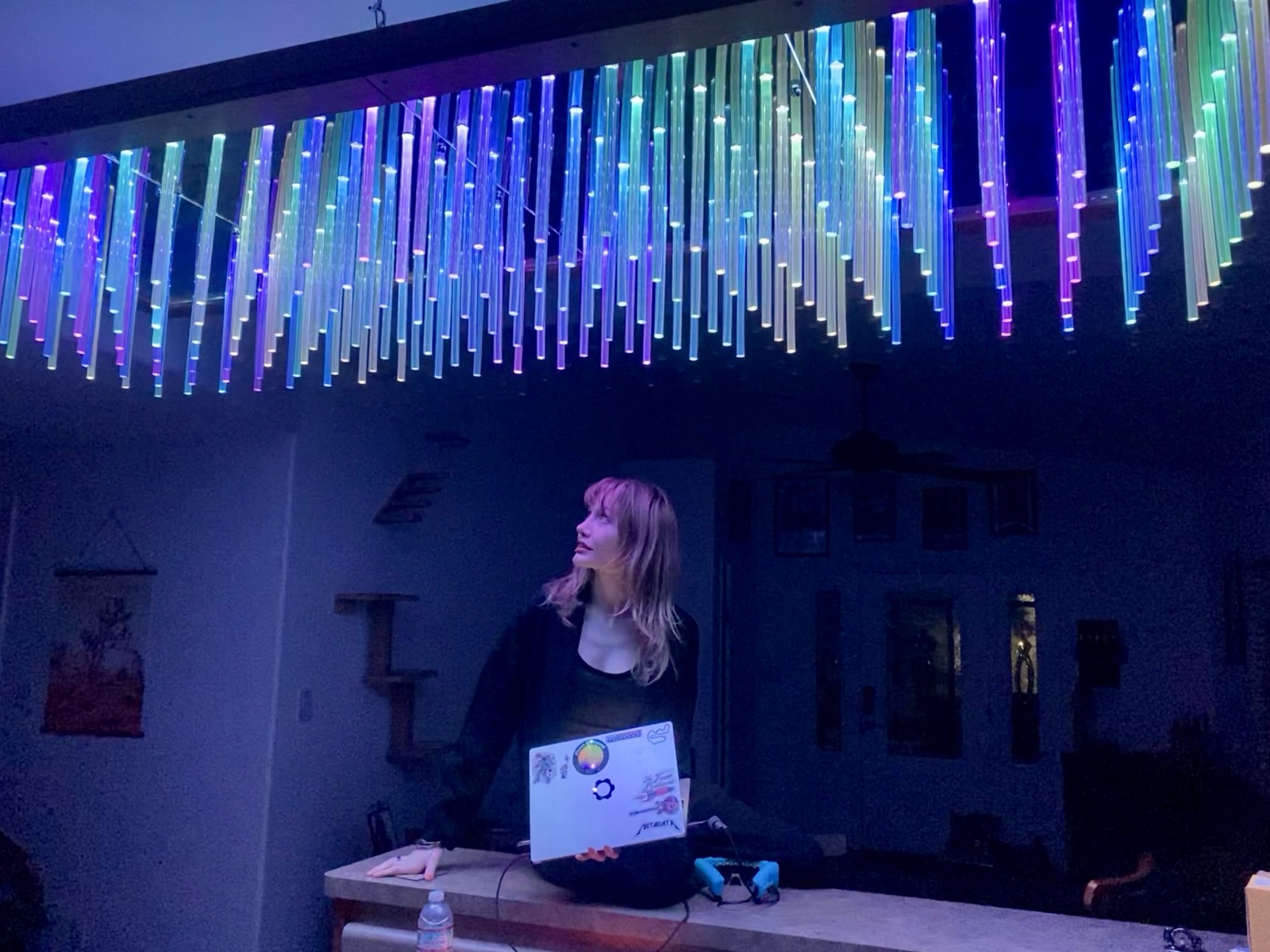
192-rod chime chandelier installation
192-rod chime chandelier & ambient array test

Room-Scale Capability

192-rod chandelier & 1,000+ LED array

Physical solenoid chimes and room-scale addressable LEDs driven live by avalanche diode entropy dynamics.

Confirmatory Solo Workstation

Extended display in darkened room

In formal confirmatory runs, the operator viewed the light display on an extended monitor in a darkened room for controlled solo focus (visual-only feedback; audio chimes were not used in these experiments).

Aesthetic Shift

Absorption vs. effort

Replaces inert fixation crosses with visual coherence as the intrinsic reinforcement signal.

The software drives both room-scale physical installations (chandelier, 1,000+ LEDs) and controlled solo displays. Coherence is the aesthetic reward.
Bursts, not mean shifts · Mason Borchard · TSC 2026 · ionospherelabs.com
4
Feedback dynamics · glitch vs. coherence

Real-time entropy maps directly to visual pattern noise and coherence

Wave PatternHigh vs. Low Glitch
Pure chance manifests as dispersed pixel glitch. Deviations resolve noise into smooth orbital wave trajectories.
Generative TetrisHigh vs. Low Glitch
A game of Tetris: high glitch causes the game to lose increasingly quickly as blocks pile up. Approaching zero glitch factor, the game clears lines and wins.
Vertical StripesHigh vs. Low Glitch
High glitch introduces jagged noise tearing and dislocation. Low glitch resolves columns into smooth, coherent vertical ribbons.
The operator does not strain to push a statistical gauge. Instead, order self-assembles from noise in real time.
Bursts, not mean shifts · Mason Borchard · TSC 2026 · ionospherelabs.com
5
Exploratory clues · the confirmatory turn

Clues that motivated sealing the design

Mason's father

Memorial balloon release

z = 4.04 · peak excursion

Dad's first birthday after his passing. Our highest reading, minutes after the balloon went up.
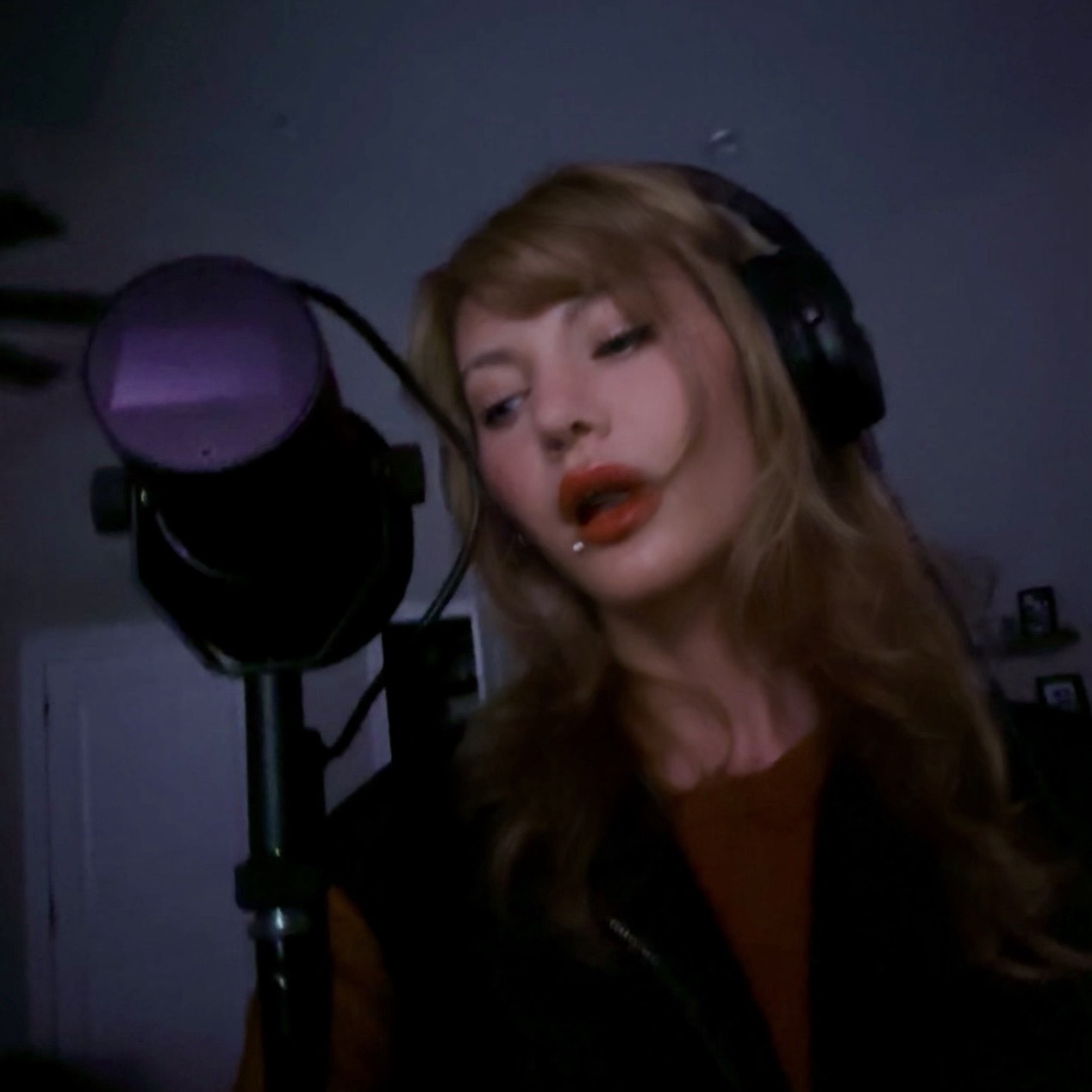
Mason singing

Musical flow

Singing & piano

Across focus periods, z tended to run high while singing or playing piano. An impression, not a score; the state logger now stamps these.

Meditators at Autumn Lights

Autumn Lights Festival

z = 3.31 when meditators arrived

4 days, 3,222 periods, aggregate null. One transient spike, uncorrected p < 0.001.

July 4 paired run

9 windows: 10.3% bursts vs 3.9%, p = 0.007. Simultaneous PRNG flat, p = 0.54.

The confirmatory turn

Post-hoc timing makes these clues, not proof. Every window, seed and analysis was then sealed in advance.

Simmons, J. P., Nelson, L. D., & Simonsohn, U. (2011). False-positive psychology. Psychol. Sci., 22, 1359.
Bursts, not mean shifts · Mason Borchard · TSC 2026 · ionospherelabs.com
6
Confirmatory architecture & pre-commitment

Hidden focus schedules, SHA-256 pre-commitments, and open channels

Schedule & Windows

Hidden 15-min blocks + K=5 buffer

6 h (380 periods) or 3.3 h (200 periods) runs. Operator blind to window starts. 5-minute post-window buffer dropped from baseline.

Pre-Commitment & Limits

SHA-256 committed in-repo

68 schedule hashes committed before collection, closing the start-timing DAT channel. Stated plainly: no OSF / KPU entry yet.

DAT ChannelStatusMitigation
Session & Window TimingClosedSchedules generated from seed and hashed prior to collection
Attendance & EngagementOpenOperator-attested per window; logged contemporaneously
Inclusion & Analysis RulesOpenLocked analysis script (SEED=0); dated audit disclosure notes
May, E. C., et al. (1995). Decision augmentation theory. J. Parapsychol., 59, 195.
Bursts, not mean shifts · Mason Borchard · TSC 2026 · ionospherelabs.com
7
The control ladder & three arms

Isolating software, hardware, and attentional contributions

Control / ArmQuestion It AnswersOperational Status
1. PRNG UnwindowedDoes the analysis pipeline create structure from pure software noise?Run & confirmed flat
2. PRNG + Schedule + AlerterDo host machine events at window transitions manufacture anomalies?2 runs (29 Sep, 5 Oct)
3. Unattended HWRNG + ScheduleDoes the physical device drift during scheduled windows with nobody present?Critical missing rung; 15–20 needed
4. Attended Human Solo (Confirmatory)Primary arm: human operator immersed in live visual feedback (solo monitor in darkened room)36 runs
5. LLM Operator (claude-fable-5)Exploratory: automated driver loop testing functional agency without humans5 runs (pooled null)
PRNG controls test the software. The unattended same-device run is the rung still missing before any device-level claim.
Bursts, not mean shifts · Mason Borchard · TSC 2026 · ionospherelabs.com
8
Companion & LLM arms · how the runs were conducted

Same rig, schedule and analysis. Only the operator changes

Human + LLM companion · 9 runs

Three-way co-meditation

  • Mason meditates through each hidden 15-min window in a text exchange with two LLM companions: a Claude “master meditator” and a GPT “researcher”.
  • They see the live z, never the schedule. Replies 1–3 sentences.

Pooled Δ = +0.017, p = 0.25 · bursts 4.7% vs 3.7%

LLM-only operator · 5 runs

No human, lights off

  • claude-fable-5 via the local CLI. 1 live pilot + 4 overnight runs. Stream off.
  • 8 sessions a night, 30 min apart; each 4 windows × 5 min, 90 s gaps, fresh conversation per window.
  • Prompt: hold a stated intention toward the bit stream (LONG or SHORT). Transcripts hashed into the manifest.

Pooled Δ = −0.035, p = 0.80 · bursts 5.5% vs 5.9%

Operator-side loggers · committed in-repo Aug 2026

Prediction & state loggers

  • Prediction logger: Enter the instant a window feels imminent. Machine-stamped, blind to schedule and z; void if a window is open. 43 eligible presses, 19 runs.
  • State logger: Enter to start and stop an absorbed state (piano, singing). 17 intervals, 7 runs; scored vs circular-shift null at 20.
The LLM arm is a procedural null. The loggers make felt moments machine-stamped, in advance.
Bursts, not mean shifts · Mason Borchard · TSC 2026 · ionospherelabs.com
9
Statistical analysis plan: circular shifts

Dependence-preserving permutation test on time series

Primary Endpoint (Dispersion)

Mean |z| In-Window vs. Baseline

20,000 circular shifts of the window mask per run. Run-stratified: runs are never concatenated.

Secondary Endpoint (Bursts)

Placement test on |z| ≥ 1.96

Tests whether 60-second burst rate difference exceeds circular-shift null expectation. Mantel-Haenszel odds ratios across runs.

Why Circular Shifts?

Autocorrelation Preservation

Naive permutation destroys temporal dependence. Shifting the intact mask over the circular series preserves exact serial dependence (Harris 2024).

Hardware verified: 251.6M raw bytes, 79 runs · 740 of 748 checks pass (98.9%, chance rate). Shifts preserve the real time dependence.
Harris, K. D. (2024). A shift test for independence in generic time series. PLOS Biology, 22(8), e3002758.
Bursts, not mean shifts · Mason Borchard · TSC 2026 · ionospherelabs.com
10
The pooled results · stated plainly

What the pooled table can and cannot say

StratumRunsIn-winBaseΔp
Human solo, all runs364,9235,911+0.0314p = 0.0062
Human solo, gate-passing253,3534,014+0.0124p = 0.2278
PRNG scheduled controls2300408+0.1413p = 0.0224
LLM-only (claude-fable-5)5785725-0.0350p = 0.7990
IN-WINDOW ENRICHMENT Δ MEAN |Z|Human solo (36)+0.031 p = 0.006Solo, gate-passing (25)+0.012 p = 0.23PRNG scheduled (2)+0.141 p = 0.022LLM-only (5)-0.035 p = 0.800
The attended arm is small and positive; the PRNG control is larger; the control that would tell them apart has not run.
Bursts, not mean shifts · Mason Borchard · TSC 2026 · ionospherelabs.com
11
Windowed runs · top sessions & burst ratios

15 of 73 windowed runs clear p < 0.05 (~3.7 expected by chance)

Run IDArmPeriods (In / Base)In-Win |z|Base |z|EnrichmentShift pBurst Odds Ratio
SOLO-25solo (6.3h)150 / 1790.94970.6801+0.2696p < 0.000111.31 × (p < 0.0001)
COMPANION-7companion (6.3h)147 / 1820.94780.6877+0.2602p = 0.01657.83 × (p < 0.0001)
PRNG-SCHED-1control (6.7h)150 / 2020.92280.7266+0.1962p = 0.03831.93 × (p = 0.1480)
15 of 73 (20.5%): 10 solo, 2 companion, 1 legacy, 1 LLM, 1 PRNG control. Top sessions: 11–16% bursts in-window vs 1–2% baseline.
Bursts, not mean shifts · Mason Borchard · TSC 2026 · ionospherelabs.com
12
Feedback coupling: ON vs OFF

Does live visual coupling modulate effect magnitude? So far, no

The Contrast

Balanced within run

Half the windows couple the glitch to the live stream; half hold it constant. Operator blind to which is active.

Empirical Result

No incremental boost (Δ = +0.019)

Within-run contrast flat: Δ = +0.019, p = 0.44. Per-run tests: 1 of 36 below 0.05, chance.

Visual Reality

Contingency vs. Immersion

OFF removes the live coupling, not the immersion: the display runs at matched intensity in both states.

The comparison isolates the incremental effect of live contingent coupling, not immersion vs non-immersion. Direct z-score monitoring sustained task engagement in both states.
Bursts, not mean shifts · Mason Borchard · TSC 2026 · ionospherelabs.com
13
System attribution & methodological boundaries

The effect belongs to the whole treatment package

System Attribution

Operator + Feedback + Instrument

Attended sessions differ in attention, luminance, EMI and body heat. We claim a whole-treatment effect, not mental causation.

Experimenter Effect

Performance pressure & anxiety

Sole operator, dual role. Wanting a high z brought performance anxiety, the opposite of effortless absorption.

Cognitive Limitations

Multi-TBI & short-term memory

Multi-TBI survivor with impaired short-term memory: windows were forgotten mid-run; fatigue and life events compounded it.

Rigor-Readiness Tradeoff

Fixed clocks vs. state readiness

Fixed clocks closed DAT, but demanded focus on command. Next: pre-register state covariates.

Anxiety, fatigue and memory lapses on a rigid clock. Future protocols must measure readiness prospectively.
Bursts, not mean shifts · Mason Borchard · TSC 2026 · ionospherelabs.com
14
Falsification: what would change our minds

Declared in advance, so it cannot be renegotiated later

Against the Hypothesis

Failure at planned sample size

Primary contrast failing at planned confirmatory N, followed by adequately powered independent replications that fail, falsifies the operational burst hypothesis.

Against the Apparatus

Unattended control matches effect

If 15–20 unattended same-device scheduled runs reproduce in-window deviations at human rates, it is a machine artifact.

Against Interim Findings

Pooled excess shrinking to null

If accumulated human-arm sessions regress to baseline expectation, the early signal was random fluctuation. That result is equally publishable.

A well-powered null is a successful outcome: it constrains effect sizes under immersive conditions and leaves behind an audited platform other laboratories can deploy.
Bursts, not mean shifts · Mason Borchard · TSC 2026 · ionospherelabs.com
15
Scholarly references

Primary Sources & Literature Foundations

Bancel, P. A. (2017). Searching for global consciousness: A review of data and methods. Explore, 13(2), 94–101.

Bösch, H., Steinkamp, F., & Boller, E. (2006). Examining psychokinesis: The interaction of human intention with random number generators--A meta-analysis. Psychol. Bull., 132(4), 497–523.

Dechamps, M. C., Maier, M. A., Pflitsch, M., & Duggan, M. (2021). Observer-dependent biases of quantum randomness. JAEX, 1(1–2), 114–155.

Dobyns, Y. H. (1996). Selection versus influence revisited: New method and conclusions. JSE, 10(2), 253–268.

Gelman, A., & Loken, E. (2013). The garden of forking paths. Working paper, Columbia Univ.

Grote, H. (2018). Commentary: Intentional observer effects on quantum randomness. Front. Psychol., 9, 1350.

Harris, K. D. (2024). A shift test for independence in generic time series. PLOS Biology, 22(8), e3002758.

Herrero-Collantes, M., & Garcia-Escartin, J. C. (2017). Quantum random number generators. Rev. Mod. Phys., 89(1), 015004.

Jahn, R. G., Dunne, B. J., Nelson, R. D., Dobyns, Y. H., & Bradish, G. J. (1997). Correlations of random binary sequences with pre-stated operator intention. JSE, 11(3), 345–367.

Jahn, R. G., et al. (2000). Mind/Machine Interaction Consortium: PortREG replication. JSE, 14(4), 499–555.

Kekecs, Z., et al. (2023). The Transparent Psi Project. Royal Society Open Science, 10(10), 191375.

Levin, M. (2015). Coupling of rational agents to quantum processes. US Patent 9,189,744 B2.

Maier, M. A., Dechamps, M. C., & Pflitsch, M. (2018). Intentional observer effects on quantum randomness. Front. Psychol., 9, 379.

May, E. C., Utts, J. M., & Spottiswoode, S. J. P. (1995). Decision augmentation theory. J. Parapsychol., 59(3), 195–220.

Nelson, R. D., et al. (1996). FieldREG anomalies in group situations. JSE, 10(1), 111–141.

Nelson, R. D., et al. (1998). FieldREG II: Consciousness field effects. JSE, 12(3), 425–454.

Pallikari, F., & Boller, E. (1999). A directional test for the investigation of PK on RNG. JSE, 13(1), 25–40.

Radin, D. I. (1993). Testing the plausibility of psi-mediated computer system anomalies. JASPR, 87(3), 291–312.

Radin, D. I., & Nelson, R. D. (1989). Evidence for consciousness-related anomalies in random physical systems. Found. Phys., 19(12), 1499–1514.

Scargle, J. D. (2002). Was there evidence for global consciousness? JSE, 16(4), 579–591.

Simmons, J. P., Nelson, L. D., & Simonsohn, U. (2011). False-positive psychology. Psychol. Sci., 22(11), 1359–1366.

Tellegen, A., & Atkinson, G. (1974). Openness to absorbing experiences. J. Abnorm. Psychol., 83(3), 268–277.

Wilson, D. B., & Shadish, W. R. (2006). On blowing trumpets to the tulips. Psychol. Bull., 132(4), 524–528.

Bursts, not mean shifts · Mason Borchard · TSC 2026 · ionospherelabs.com
16
Core takeaway & open data

Projects, collaborations, and open resources

The Synapse

thesynapse.co QR

thesynapse.co

Mason: Tech lead, program planner
Dani: Part of Synapse

Aegix Linux

aegixlinux.org QR

aegixlinux.org

Mason & Timothy: Co-founders
Open-source deterministic OS

Ionosphere Platform

ionospherelabs.com QR

ionospherelabs.com

79-run audit • Live stream
68 schedule commitments

Research Portal

masonborchard.com QR

masonborchard.com

Conference papers • Slide decks
Statistical methods notebooks

The complete 32-slide Master Reference Deck and full 79-run audit report are available online. Questions?
Bursts, not mean shifts · Mason Borchard · TSC 2026 · ionospherelabs.com
17
←→ move · T theme [Switch to 32-Slide Master Deck]